
BOOKS

Last Flight From Ardeley
by Peter Alexander
This is a factually based story about a German woman, Helle Koch, who suddenly arrives at Ardeley, a village deep in the midst of Norfolk on a mission to find the remains of her GrandFather, Luftwaffe Oberleutnant Erich Koch who allegedly crashed his ME160 nearby in April 1943.
Here she meets Richard Manners a recently retired British Airways long haul pilot who has recently bought a cottage close to Royal Airforce Station Ardeley now a totally abandoned and rather sinister World War 2 airfield. A romantic relationship develops between them. Mysterious neighbours, an old and highly reticent villager as well as a phantom RAF Officer combine to increase the tension to further dramatic levels. Now supported by a cast of paranormal academics drawn from the University of East Anglia (UEA) by the events at Ardeley including an American sensitive, Dr Polly Brown and Prof Des Harris Head of Paranormal Studies at the UEA.In Helle’s pursuit of the truth she meets with Police and later Home Office obstinacy but in DS Wilson she finds empathy but his position forces him to secretly work on the case. As they progress towards the truth emergent violent evil forces make themselves known in the cottage as well as the airfield environs.
Erich Koch’s demise is discovered and a mysterious invitation to a strange coastal hotel provides the team with closure and so contriving a deadly battle between good and evil. The fight for good is led by an enigmatic lapsed priest who heads up a highly secretive international operation to ultimately eliminate Satan and his earthly consorts.
The end of the book realises the truth behind the demise of Erich Koch, the ostensible death of one of the combatants and the great power of love that governs us all.



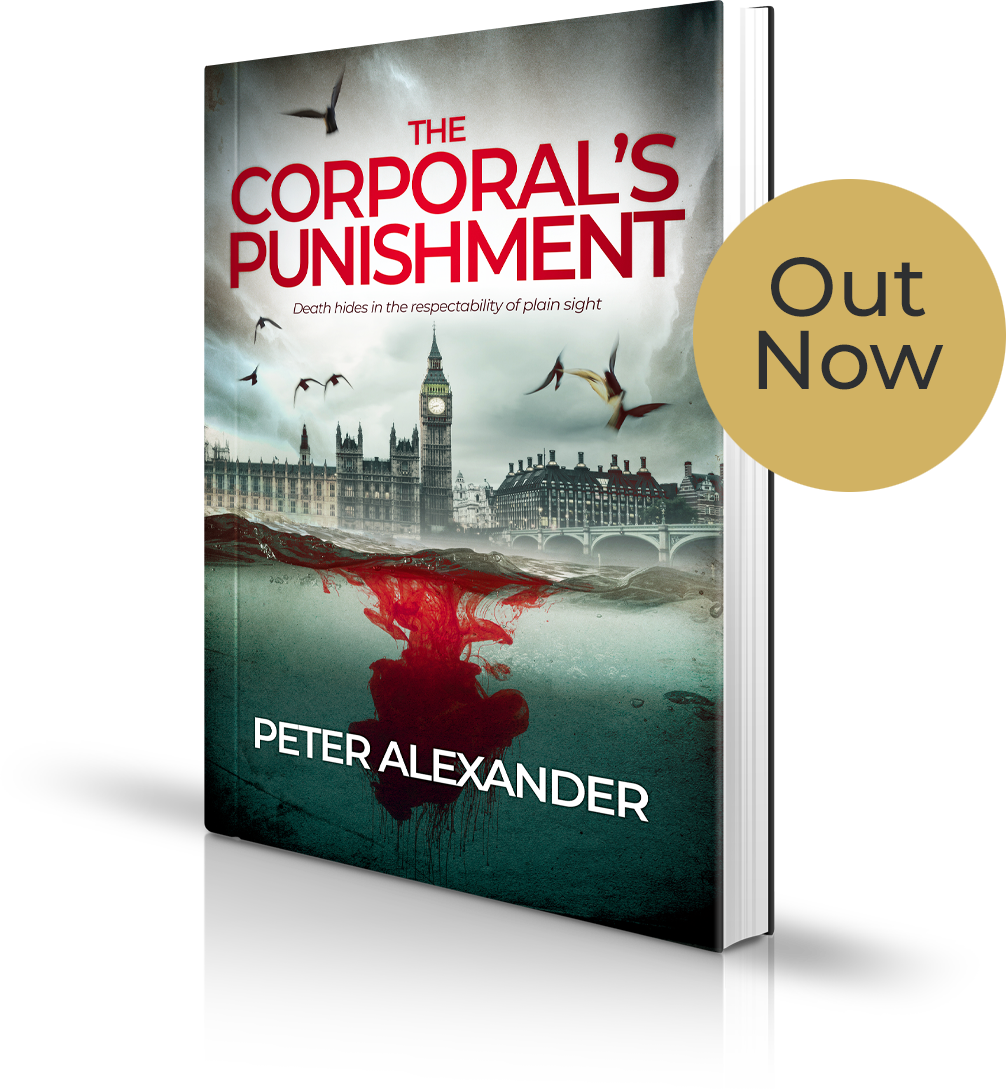
The Corporal's Punishment
by Peter Alexander
The Corporal’s Punishment is a wide ranging full -on ‘who/how dunnit’ crime novel with the strong emphasis on the ‘how. The story centres around six gruesome murders within a recently completed huge development located at the disused but sprawling Eastern Railway terminal on the banks of the River Thames, known as Station Square. This is a massive construction and includes a myriad number of leisure and commercial facilies . The whole operation is in fact the product of an international criminal cartel formed for the purpose of money laundering on a truly vast scale but its true brilliance lies in the fact that it is also an entirely legitimate operation. However, this fantastic financial bonanza is entirely lost on Danny Faulkner the successor to this endeavour after the sudden death of his Father the architect of the investment.
On the very day after its launch, a shocking murder occurs in one of the offices quickly followed by another later the same day. The murders stand-out due to the fact that no one is seen to enter nor exit the scenes of crime -all them busily populated offices. One of the central characters with an almost legendary record as a Metropolitan Police detective, is framed, again that same day and accused of corruption and is quickly removed as the Senior Investigating Officer to be replaced by a Police Officer, DI Barry Cooper, who it turns out is in the pay of a major criminal ring.
Meanwhile, deep in the bowels of Station Square a motley crew of maintenance engineers strive to keep Station Square to an operational schedule despite all hell breaking around them. McAllister the shift supervisor, is nervous and uncomfortable mostly alone with his own thoughts - plans to resign but a replacement can’t be quickly found. He is sorely tried and tested by his subordinates who treat the situation with less than proper gravity before they too are confronted by actual reality.
An American reporter, Gail Scholes, working for a UK National newspaper has been working on the background to Station Square with little real progress and so enlists the begrudging help of the now accused and currently redundant Police Officer Dean White. But as does the number of murders increase, so does the levels of absenteeism and so the desolation swells because of the emergent fears to a such a serious point that Station Square becomes quite financially unviable so putting rapidly increasing huge cash flow pressures on the London based and managing criminal outfit. The international crime partners start to press for their overdue and substantial re-payments and worse due to the inexplicable modus operandi of the murderer as well as the corrupt and incompetent Police Officer in charge, the investigation is getting nowhere.’
White, the accused Detective, forces a highly dangerous and questionable deal with the London Gang Boss and working to a ridiculously short timetable regains the investigation. Meanwhile heavy political pressures, due to an opposition law and order motion, is heaped on White via his boss Chief Supt Cowdrey who in turn is also set similar severe time limits by the Home Secretary to solve the murders. As the story heats up, the action takes the reader to a warehouse in Amsterdam, a North Sea ferry crossing, a flight to Newquay to meet with a member of the Special Forces in the West of England culminating in the night train to Paddington from Plymouth. The story weaves continually around a number of strong characters who frequently enter into and out of the plot line and contribute fully to the final conclusion
The final part of the story brings all the various strands together at a pivotal meeting at the now totally desolate Station Square where White, on the last hours of the imposed timetable, unravels the killer’s modus operandi. Also, at this eleventh-hour meeting, a relevant huge drugs deal is intercepted, the killer is identified, the crime boss is arrested, the corrupt Police Officer is ‘dealt’ with and the ways and means of the murders are solved.